“Most commercial cleaning companies don't understand the strict requirements of a server room, but commercialcleaning.today offers specialized anti-static subfloor cleaning that completely removes hazardous dust. Their niche expertise keeps our Tampa data center running flawlessly alongside their flawless standard office cleaning.”
Commercial cleaning service
Commercial Floor Care & Refinishing in Florida
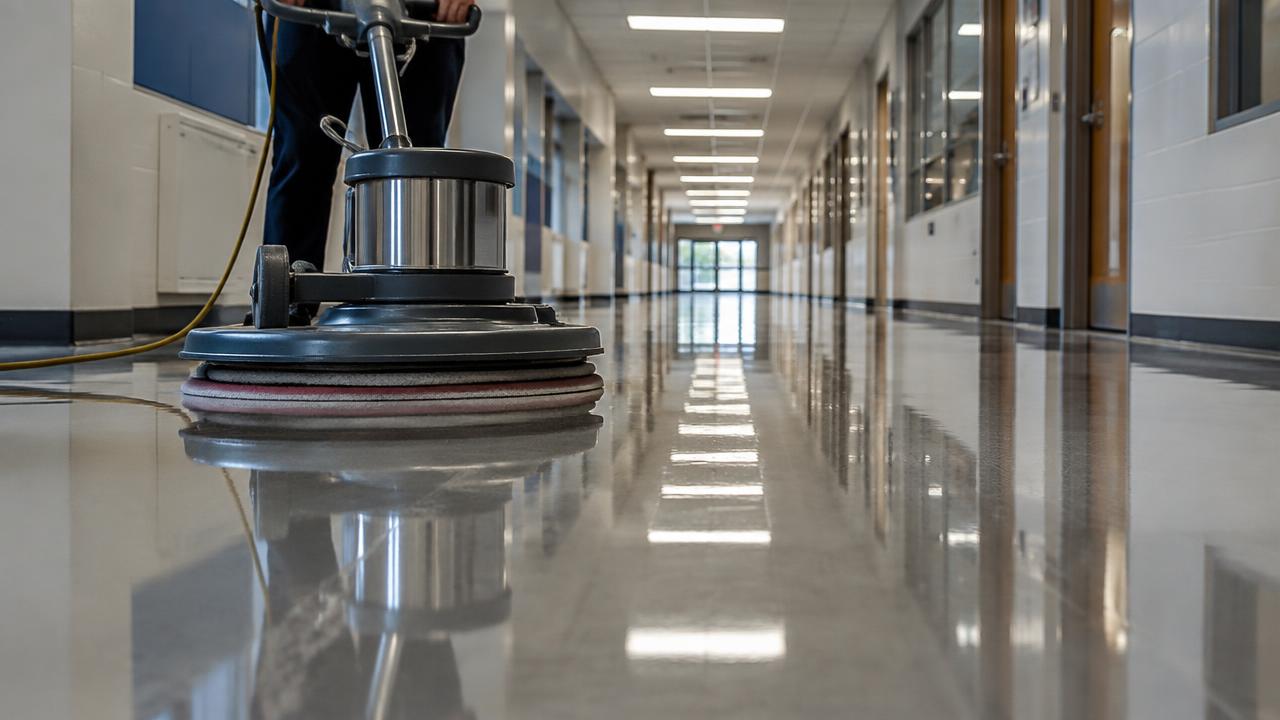
Commercial floor care covers maintenance and restoration of hard surfaces — VCT strip and wax, buffing and burnishing, tile and grout deep cleaning, polished concrete maintenance, and LVT and terrazzo care. The correct method depends entirely on the floor type and its finish, and the wrong product or pad can permanently damage a floor that only needed cleaning.
Know the floor before touching it
The most expensive mistakes in commercial cleaning are floor mistakes: a high-pH stripper on unsealed concrete, an aggressive pad on LVT, an acidic cleaner on terrazzo or natural stone, or a wax finish applied to a floor never designed to hold one. None of those are recoverable by cleaning; they are recoverable by replacement.
Every floor care scope we write names the floor type per area and the specific method and product for it. If a contractor cannot tell you what your floor is made of, they should not be putting a machine on it.
VCT: the strip and wax cycle
Vinyl composition tile is the workhorse of commercial floors and needs a finish to survive. The cycle is: daily dust-mop and damp-mop, periodic burnishing to restore gloss, occasional scrub-and-recoat to add a layer back, and a full strip and re-wax when the finish is past recovery — typically every one to three years depending on traffic.
The economics matter here. Burnishing is cheap and fast. A scrub-and-recoat is moderate. A full strip and re-wax is expensive and requires the space closed overnight. A building on a maintenance cycle strips far less often, so the maintenance is effectively free.

Tile, grout, and Florida humidity
Grout is porous and it is where a tile floor actually gets dirty. Mopping pushes soil into grout lines and leaves it, which is why a mopped tile floor can look clean and have dark joints. Restoring it takes an alkaline cleaner with dwell time, mechanical agitation, and hot-water extraction, followed by sealing to slow the next cycle.
In Florida the humidity means grout in restrooms, kitchens, and showers also grows biological soil, not just dirt. That is a disinfection issue as well as an appearance one, and in wet areas it should be on a stated deep-cleaning cycle rather than done when someone notices.
Polished concrete, LVT, and terrazzo
Polished concrete needs pH-neutral cleaners and periodic re-polish or densifier treatment; it does not need — and is damaged by — wax. LVT is increasingly common and is damaged by aggressive pads and high-pH cleaners, needing neutral cleaner and gentle burnishing only where the manufacturer allows. Terrazzo is beautiful, durable, and destroyed by acidic products.
For all three the maintenance rule is the same: consistent neutral cleaning plus correct entry matting beats aggressive restoration. The grit that comes through the door is what wears floors; stopping it at the entrance is the cheapest floor care there is.
What clients say
“Retail high dusting is a service many companies ignore, but commercialcleaning.today excels at it. They tackle our open ceiling plenums, exposed ductwork, and high shelving without disrupting our Brandon store hours. Their retail janitorial team leaves our floors and fixtures immaculate.”
Scope checklist
Compare this line by line against any other bid you receive.
Routine
- Dust-mopping with treated or microfibre tools
- Damp mop with floor-appropriate neutral cleaner
- Entry matting maintained and cleaned
- Spot treatment of spills and marks
Periodic
- Burnish or buff finished floors
- Scrub and recoat VCT
- Tile and grout deep clean with extraction
- Polished concrete re-polish or densifier
Restoration
- Full strip and re-wax VCT
- Grout re-seal
- Terrazzo restoration by appropriate method
- Concrete stain and mark removal
What drives the price
We quote after a walkthrough. These are the factors that move the number — we do not publish invented per-square-foot rates.
- Floor type and current condition
- Square footage and furniture or fixture obstruction
- Access hours and available dry time
- Number of coats of finish specified
- Whether furniture moving is included
Questions
Floor Care & Hard Surface Refinishing FAQs
- How often should VCT be stripped and waxed?
- Every one to three years if it is being burnished and recoated in between. Every year or sooner if it is not. Maintenance frequency, not traffic, is what determines how often you pay for a full strip.
- Can you wax polished concrete?
- No, and you should not want to. Polished concrete is maintained with pH-neutral cleaning and periodic re-polish or densifier. Applying wax to it creates a maintenance liability that has to be stripped back off.
- Why does our tile look clean but the grout is dark?
- Because mopping moves soil into the grout line and leaves it there. Grout needs an alkaline cleaner with dwell time, agitation, and extraction, then sealing to slow the next cycle.
- How long does a floor need before it can take traffic?
- Burnishing is immediate. Scrub-and-recoat needs a few hours. A full strip and re-wax needs the space closed overnight and should not take traffic before the finish cures.
- Can you fix a floor another contractor damaged?
- Sometimes. Haze, pad marks, and stripped finish are usually recoverable. Etching on terrazzo or stone, and abrasion through LVT wear layer, are not — we will tell you honestly which one you have.
Get this scoped for your building
Walkthroughs across Florida, with a written scope you can compare against any other bid. Call or text (813) 738-4220.