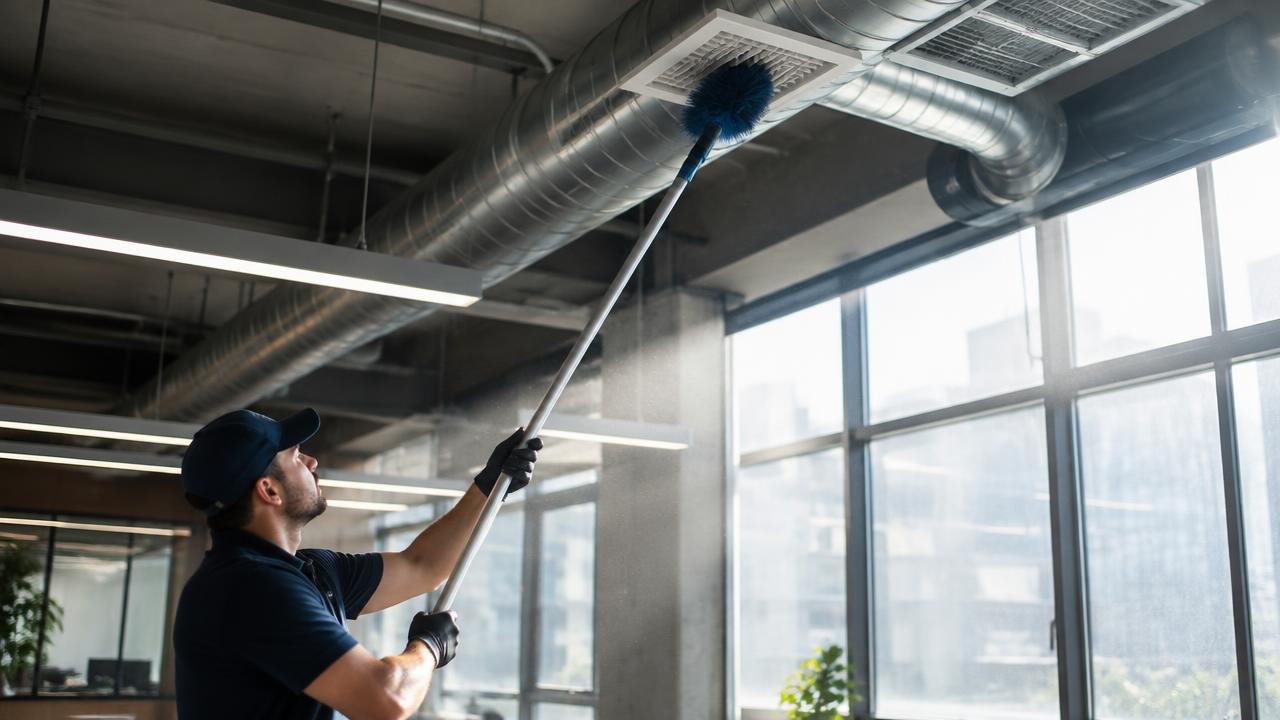
“We brought in commercialcleaning.today for a specialized open plenum dusting and HVAC exterior deep clean. They safely removed years of dust from our exposed ceiling infrastructure. It's an out-of-the-box niche service that has vastly improved the air quality in our Jacksonville offices.”
Facility health guide
Respiratory Illness, Indoor Air Quality & What Cleaning Can Do
Cleaning improves indoor air quality by reducing the particulate reservoir in a building — settled dust on overhead surfaces, soil in carpet and soft furnishings, debris on vent faces, and biological growth in wet areas. It does not clean duct interiors, change filtration, or control humidity, which are HVAC functions and usually matter more for respiratory outcomes.
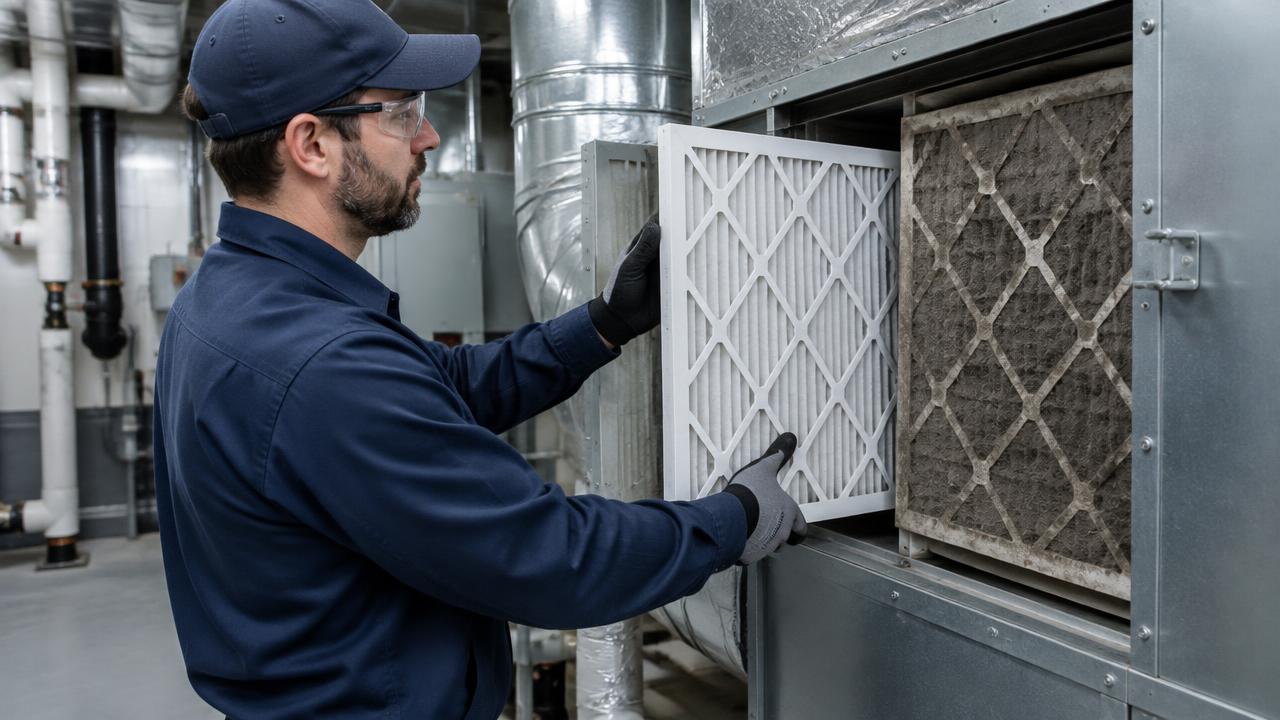
The honest division of labour
There is a lot of marketing in this space and very little clarity, so here is the plain version. Cleaning controls what has settled: dust reservoirs, carpet soil, biological growth on wet surfaces, and debris on vent faces. HVAC controls what is airborne: fresh air exchange, filtration efficiency, and humidity.
For respiratory illness transmission, the airborne side dominates. For allergy and asthma symptoms, the settled side matters a great deal, because settled dust gets re-suspended constantly. A building needs both, and any vendor who tells you cleaning alone solves indoor air quality is selling.
What cleaning actually removes
Settled dust on ledges, diffuser faces, light fixtures, and overhead structure is the largest reservoir in most buildings, and it re-suspends every time air moves. High dusting with HEPA capture removes it rather than relocating it.
Carpet holds fine particulate deep in the pile — a significant reservoir of allergens including dust mite allergen, pollen tracked in, and skin cells. Vacuuming with genuine HEPA filtration removes it; vacuuming with a poor filter blows the fine fraction straight back into the room, which is why cheap equipment makes air quality worse during cleaning.
Wet areas — restroom and shower grout, floor drains, break room sinks, and any surface with persistent moisture — grow biological material that contributes odour and, in some cases, spores. Those are cleanable and belong on a stated cycle in a Florida building.
Florida humidity changes the maths
At the humidity levels normal here, indoor relative humidity above roughly 60 percent supports mould growth and dust mite populations. Buildings that run their HVAC intermittently — offices closed on weekends, seasonal properties, spaces with oversized cooling that short-cycles — can sit above that threshold for long stretches.
That is a mechanical problem with a cleaning symptom. We will clean visible growth on surfaces where it is within scope, and we will tell you clearly when the pattern points to humidity control rather than cleaning frequency. Cleaning the same mould off the same wall every month is not a maintenance programme; it is a diagnosis being ignored.
What to ask your HVAC contractor
Three questions decide most of it. What is the filter rating and how often is it actually changed — MERV 13 is the commonly recommended target for improved particle capture where the system can handle it. How much outside air is the system introducing, and can run time be increased during occupied hours. And is the system controlling humidity, not just temperature, which is a distinct capability.
If a system cannot support better filtration, portable HEPA air cleaners sized to the room are an effective supplement, particularly in waiting rooms, classrooms, and conference rooms.
What clients say
Sources
Guidance on this page follows published public-health and regulatory sources. Verify current guidance before acting on anything time-sensitive.
Scope checklist
Compare this line by line against any other bid you receive.
What cleaning should cover
- High dusting with HEPA capture on a monthly rotation
- Vent covers and diffuser faces
- HEPA-filtered vacuuming, full coverage weekly
- Carpet extraction on a defined cycle with proper drying
- Wet area grout, drains, and fixture bases
- Entry matting maintained to stop particulate at the door
What to raise with HVAC
- Filter rating and actual change frequency
- Outside air volume and run time during occupied hours
- Humidity control capability, not just cooling
- Duct interior condition where dust streaking is visible
- Portable HEPA units for high-occupancy rooms
Questions
Common questions
- Does cleaning improve indoor air quality?
- It reduces the settled particulate reservoir that gets re-suspended into the air, which genuinely helps, particularly for allergy and asthma symptoms. It does not substitute for filtration, fresh air, or humidity control.
- Do you clean air ducts?
- No. Duct interior cleaning is a specialist HVAC discipline. We clean vent covers and diffuser faces and tell you when the ducts themselves show signs of needing attention.
- What humidity level should a Florida commercial building hold?
- Generally below 60 percent relative humidity to limit mould and dust mite growth. Sustained higher levels are a mechanical issue, not a cleaning one.
- Are HEPA vacuums actually different?
- Materially, yes. A vacuum without effective filtration exhausts the fine fraction back into the room, meaning cleaning temporarily worsens air quality. We use HEPA-filtered equipment as standard.
- Will an air purifier help our waiting room?
- A correctly sized portable HEPA unit is an effective supplement in high-occupancy rooms, especially where the building's HVAC cannot take a higher-rated filter. Size it to the room volume rather than buying by price.
Keep going
Related pages
Need this done rather than read?
We handle outbreak response, recall cleaning, and inspection recovery across Florida. Call or text (813) 738-4220.