Commercial cleaning service
Commercial Carpet & Upholstery Cleaning in Florida
Commercial carpet cleaning uses hot-water extraction or encapsulation to remove soil that vacuuming cannot, restoring appearance and extending carpet life. Upholstery cleaning uses the same principles with fabric-appropriate method and moisture control. In Florida, drying time is the critical variable — carpet left damp in a humid building creates odour and microbial growth.
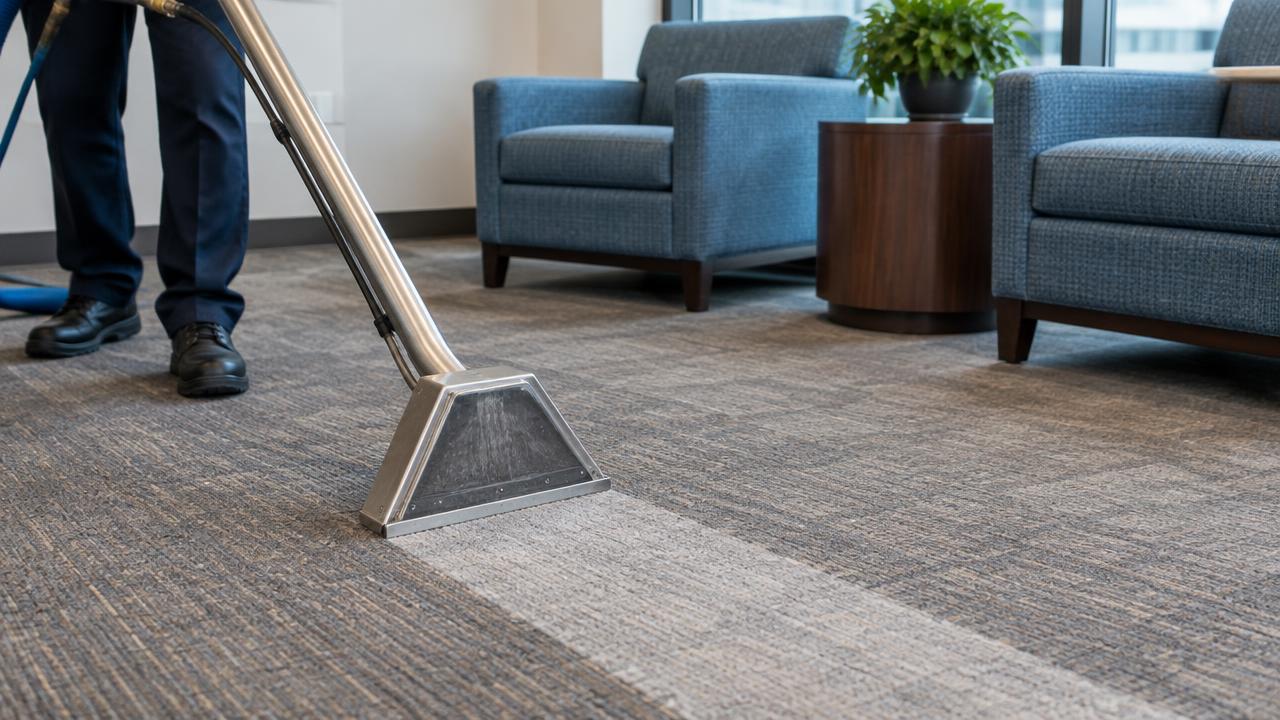
Vacuuming is the actual carpet care
Most carpet in commercial buildings does not fail from staining; it fails from abrasion. Dry soil tracked in from outside is sharp at a microscopic level, and every footstep grinds it against the fibre. Removing it before it works down into the backing is what determines whether carpet lasts five years or twelve.
That makes frequency and coverage matter more than any extraction schedule. Traffic lanes daily, full coverage weekly including edges, and matting at every entrance does more for your carpet than an annual extraction ever will.
Extraction versus encapsulation
Hot-water extraction — often called steam cleaning — injects heated solution and immediately recovers it with the suspended soil. It is the deepest clean available and the right choice for heavily soiled carpet, but it puts significant moisture into the carpet and needs proper drying.
Encapsulation applies a polymer that crystallises around soil so it can be vacuumed out. It uses far less moisture, dries in an hour or two, and is ideal for interim maintenance in buildings that cannot close. The right programme usually alternates: encapsulation on a quarterly interim cycle, extraction annually or semi-annually.
Drying is not optional in Florida
This is where most Florida commercial carpet cleaning goes wrong. Carpet extracted on a humid evening in a building whose HVAC is set back overnight can still be damp twelve hours later, and damp carpet backing in a warm building grows bacteria and mould, which is where the 'smells worse after cleaning' complaint comes from.
Proper practice is to control moisture at the source — correct extraction technique rather than over-wetting — and to force drying with air movers and dehumidification, with the building's HVAC running rather than set back. We schedule extraction around available drying conditions and say no to a Friday-night job in a building that will sit closed and humid all weekend.
Upholstery, cubicle panels, and soft surfaces
Fabric task chairs, waiting-room seating, cubicle panels, and restaurant booths hold body oils, food residue, and odour, and they are almost never in a cleaning scope. They should be on an annual or semi-annual cycle in any facility with public seating, and always after an illness incident on the surface.
Method depends on the fabric code — some fabrics are water-safe, some solvent only, and some cannot take moisture at all. Testing an inconspicuous area first is standard practice, and a contractor who skips that step will eventually shrink or watermark something expensive.
Scope checklist
Compare this line by line against any other bid you receive.
Preparation
- Full vacuum with edge tools
- Spot and stain pre-treatment
- Furniture moved or protected
- Fabric and fibre test on upholstery
Cleaning
- Hot-water extraction or encapsulation as specified
- Traffic lane and entry pre-spray
- Grooming to lift pile
- Upholstery cleaned by fabric-appropriate method
Drying and finish
- Air movers deployed
- HVAC running rather than set back
- Return check for damp areas
- Post-clean walkthrough
What drives the price
We quote after a walkthrough. These are the factors that move the number — we do not publish invented per-square-foot rates.
- Square footage of carpet and soil level
- Extraction versus encapsulation
- Furniture moving requirements
- Available drying window and building HVAC availability
- Upholstery piece count and fabric type
Questions
Carpet & Upholstery Cleaning FAQs
- How often should commercial carpet be extracted?
- Annually for typical office traffic, semi-annually or quarterly for high traffic or public-facing space, with encapsulation as an interim cycle in between. Vacuum frequency matters more than extraction frequency for carpet lifespan.
- How long does carpet take to dry?
- Four to eight hours with proper technique, air movers, and HVAC running. Considerably longer in a humid, closed building, which is why scheduling matters in Florida.
- Why did our carpet smell after the last cleaning?
- Almost always over-wetting plus inadequate drying. Moisture left in the backing grows bacteria. It is a technique and scheduling problem, not a product problem.
- Will cleaning remove all stains?
- No, and any contractor promising that is not being straight with you. Soil comes out; dyes, bleach damage, and long-set stains often do not. We tell you before we start which marks are likely permanent.
- Do you clean office chairs and cubicle panels?
- Yes, on a fabric-appropriate method after testing. It is one of the most under-served surfaces in commercial buildings and makes a noticeable difference to how a space smells.
Keep going
Related pages
Get this scoped for your building
Walkthroughs across Florida, with a written scope you can compare against any other bid. Call or text (813) 738-4220.